

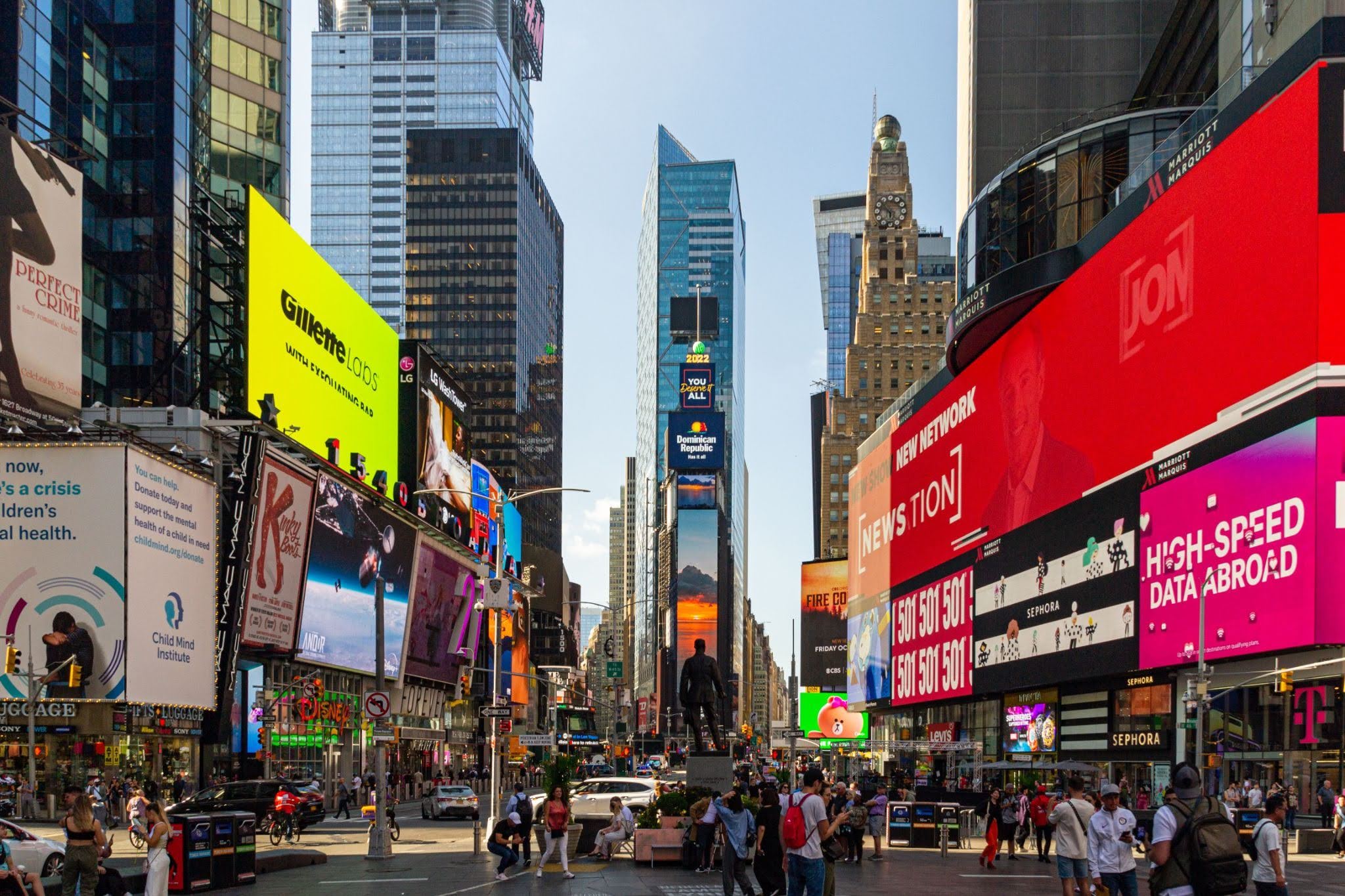
Billboard advertising has been part of the marketing landscape for over a century. And despite the rise of social media, paid search, and programmatic display, outdoor advertising is not only surviving, it is growing. Brands that understand the different types of billboard advertising and match each format to the right campaign objective tend to see stronger recall and more brand trust.
This guide covers every major billboard format, how each one works, what it costs, and how to decide which option is right for your business.
A billboard is a large-format outdoor advertisement placed in high-traffic locations to deliver a brand message to a mass audience. The term covers a wide range of formats, from the classic static roadside sign to fully animated digital displays, wrapped vehicles, transit shelters, and larger-than-life wallscapes painted directly onto buildings.
In a digital-first world, it is fair to ask whether billboards still hold relevance. The data says yes, and by a significant margin. In a recent Bloom Ads survey, we learned that only 6.67% of consumers wouldn't take any action after seeing a billboard or outdoor ad.
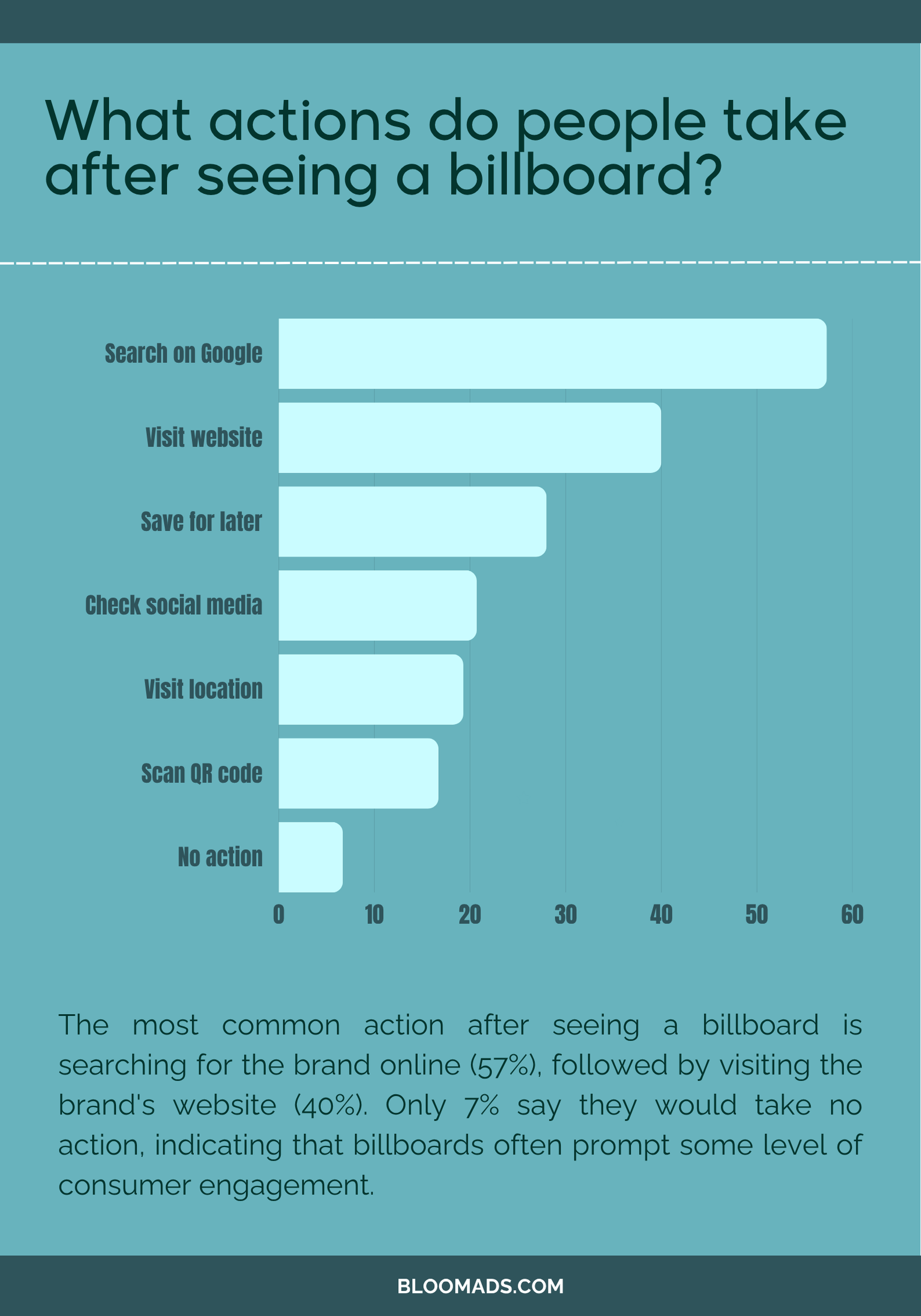
Our research consistently shows that outdoor advertising drives real consumer behavior. When people see a billboard that catches their attention, the most common follow-up action is searching on Google, followed by visiting the brand's website directly. In other words, a well-placed billboard feeds directly into the digital funnel, generating organic search demand and direct traffic that digital marketers often attribute to other channels.
Billboards also punch above their weight when it comes to purchase influence. Local businesses and retail products top the list of categories where consumers report that billboards influenced a buying decision, followed closely by entertainment and store or mall visits.
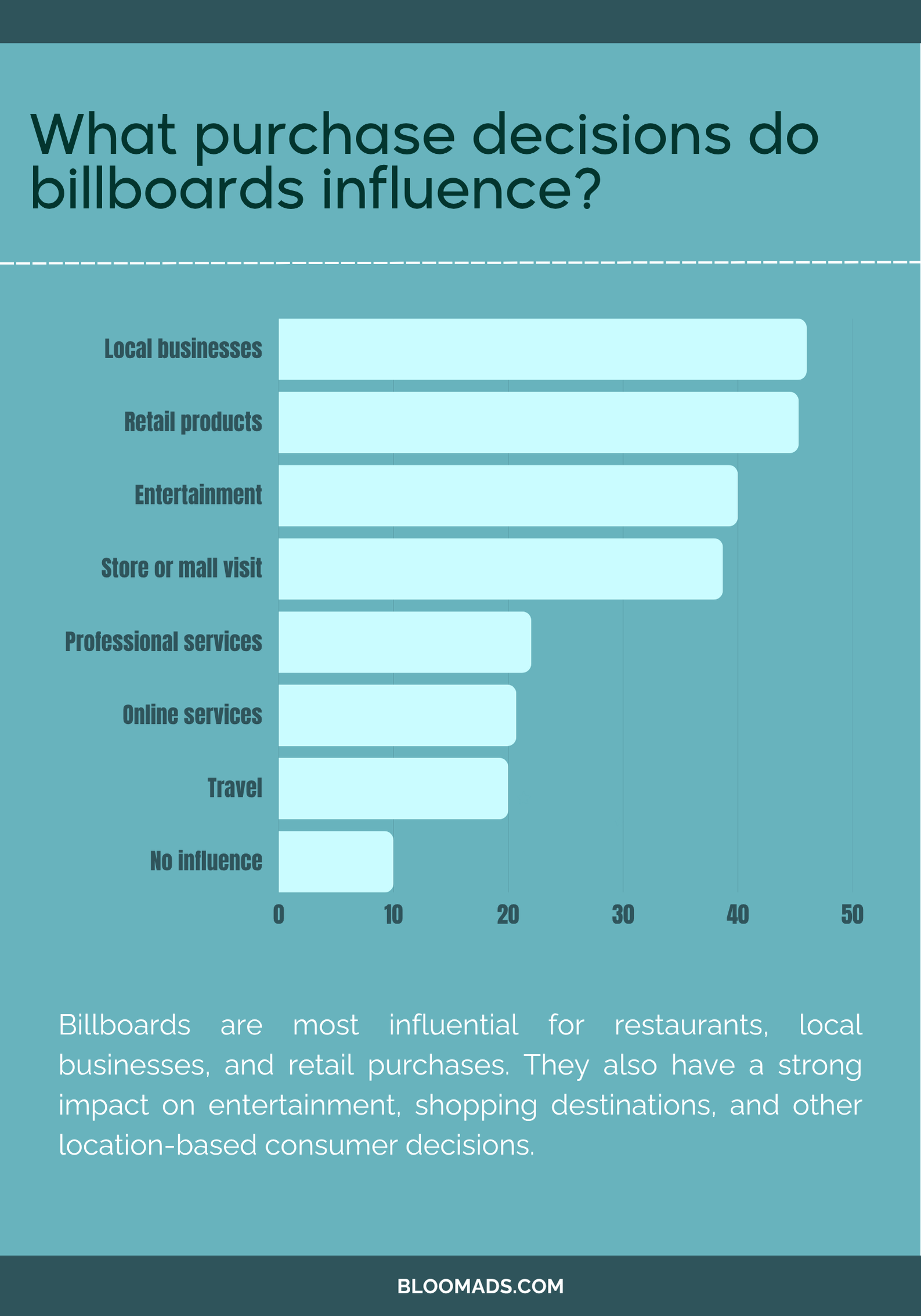
For brands with a physical presence or a geographically concentrated customer base, outdoor advertising is one of the few channels that reaches people while they are already in motion and close to the point of purchase.
The format also builds trust in a way that digital ads struggle to match. Because a billboard requires a physical commitment, a contract, production costs, and a real location, consumers perceive the brand behind it as established and credible. That perception carries weight at every stage of the funnel.
Static billboards are the original format and still represent the backbone of out-of-home advertising. These are the large, single-image displays printed on vinyl or paper and mounted on structures along highways, arterial roads, and in urban centers.
How they work. A static billboard displays one advertisement for the full duration of the contract, typically ranging from four weeks to a full year. The advertiser provides print-ready artwork, and the operator handles installation and maintenance. Visibility is continuous, 24 hours a day, with no competing messages rotating through the same space.
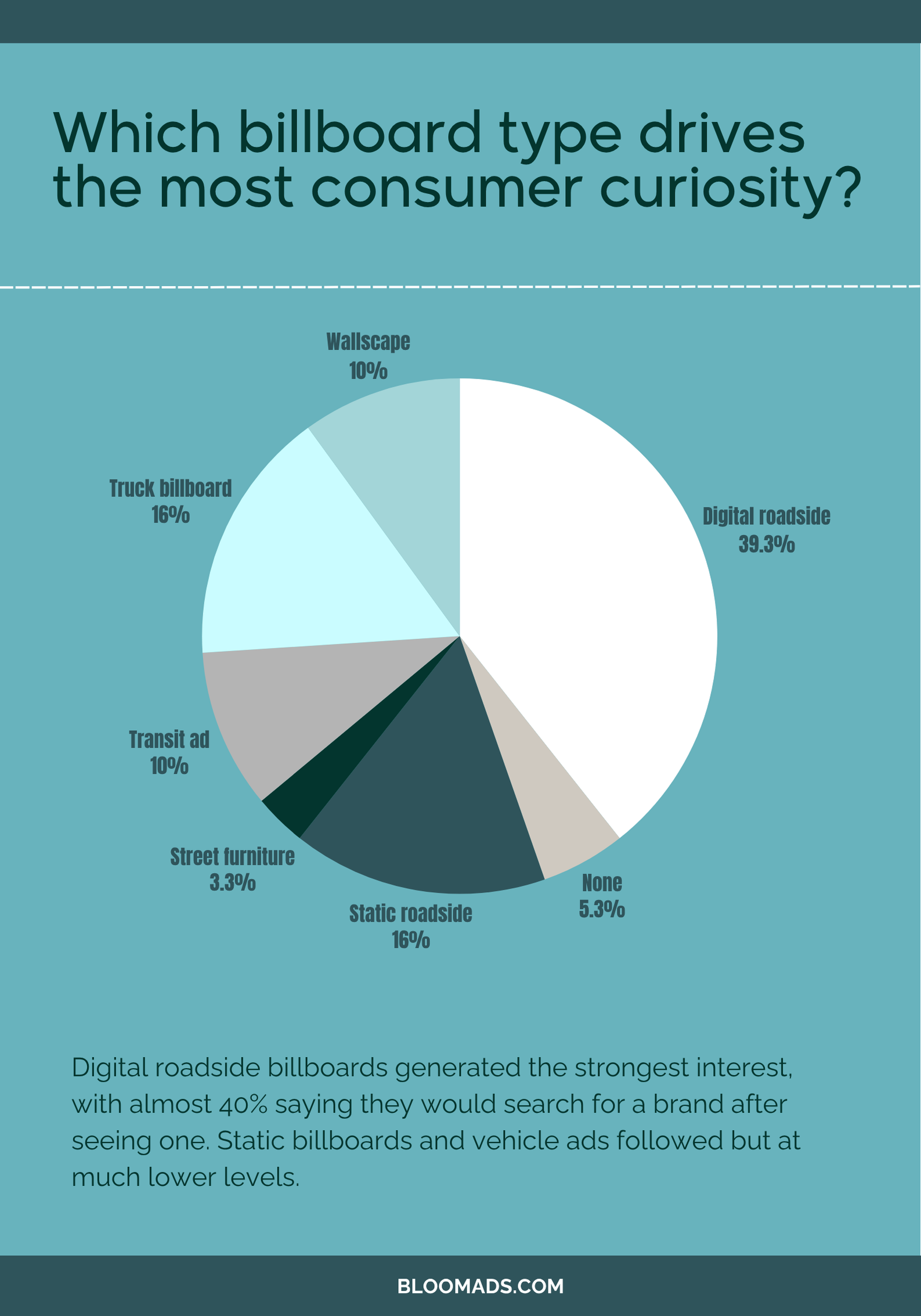
Where they perform best. Highway and interstate locations work well for brands targeting commuters, tourists, and regional audiences. Urban static boards in pedestrian-heavy areas are strong for local businesses, retail, restaurants, and entertainment venues where proximity to the audience matters. 16% of consumers say that static billboard ads actually drive the most curiosity.
Creative considerations. Because drivers have roughly five to seven seconds to absorb a billboard message, the most effective static boards follow a simple formula: one strong visual, one clear message, and a brand identifier. The headline should be readable at highway speeds, which typically means no more than seven words.
Strengths. Lower cost per impression, extended dwell time for a single message, no creative rotation fatigue, and wide availability across markets of all sizes.
Limitations. Artwork cannot be changed without reprinting and reinstallation. Time-sensitive offers require advance planning. Creative cannot be updated in response to current events or campaign performance.
Digital out-of-home advertising, commonly called DOOH, has transformed what outdoor media can do. Digital billboards use LED panels to display rotating content that changes every few seconds, allowing multiple advertisers to share a single structure and giving brands the ability to update creative in near real time.
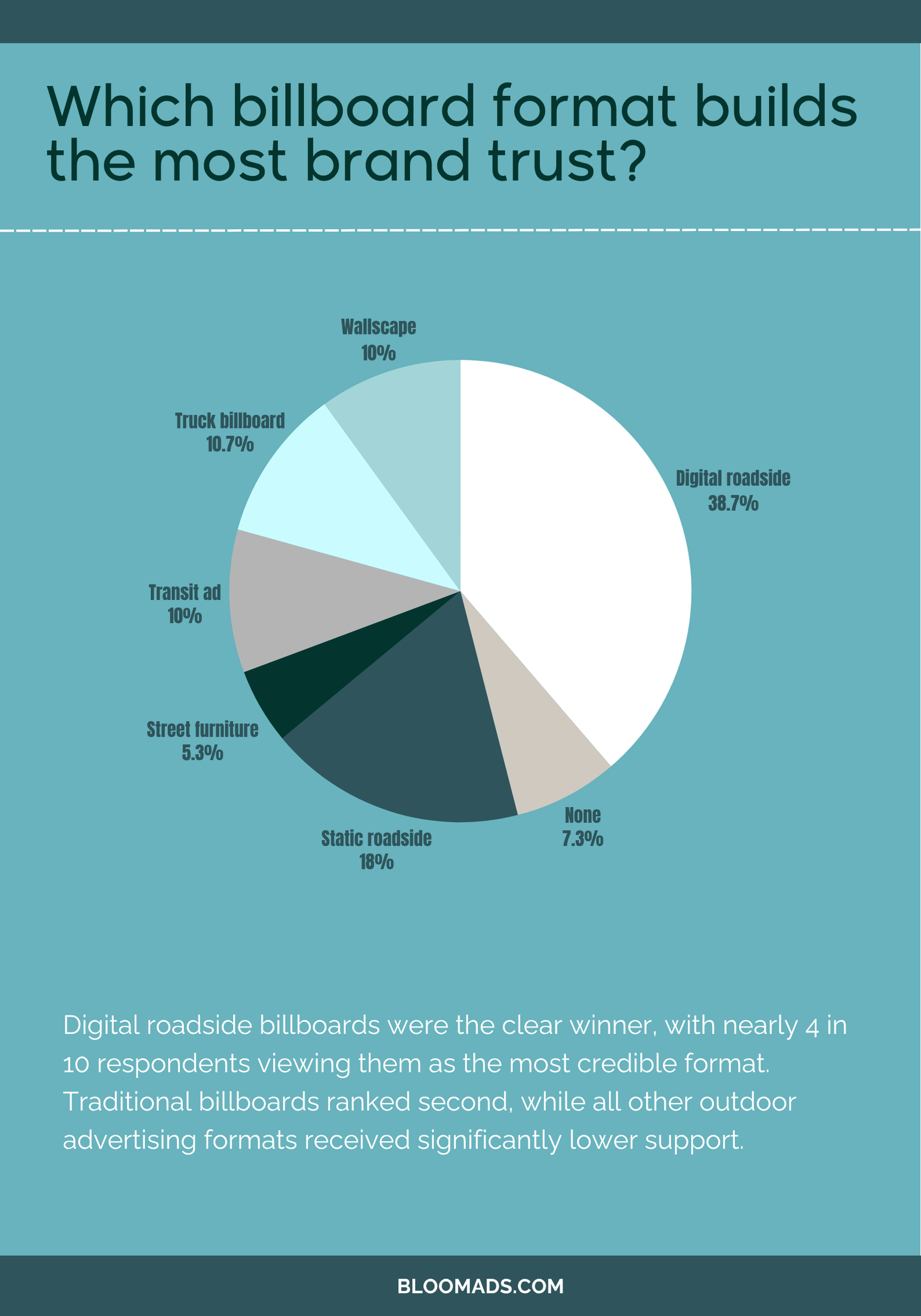
Survey data on brand trust and consumer curiosity points consistently to digital roadside as the standout format. Nearly 39 percent of respondents identified digital roadside as the billboard type most likely to build brand trust, and the same format topped the rankings for driving consumer curiosity. No other format even came close.
How they work. Digital billboard operators sell time slots rather than exclusive placement. A typical loop runs between six and eight advertisers, with each brand getting a 6-to-10-second display window every 60 to 90 seconds. Advertisers upload artwork directly to a content management system, and changes can go live within hours.
Where they perform best. High-traffic intersections, freeway corridors, urban centers, and entertainment districts are ideal environments. Digital boards perform especially well for time-sensitive campaigns, event promotions, product launches, and anything that benefits from dayparting, showing different creative at different times of day. The updating screen could catch some eyes, which is a unique advantage that static billboards can't claim.
Creative considerations. Motion and animation increase attention capture but must be used deliberately. Because the display rotates, the message needs to land within the first two seconds. Bright, high-contrast design with minimal copy tends to outperform dense layouts.
Strengths. Real-time creative updates, dayparting capability, lower minimum spend in some markets, strong brand recall, and the ability to run A/B creative tests across the same location.
Limitations. Shared display time means less exclusivity. CPMs are typically higher than static. Also not available in all markets, particularly smaller or more rural areas.
Mobile billboards bring the advertisement to the audience rather than waiting for the audience to pass a fixed location. These are large-format displays mounted on trucks or trailers that drive predetermined routes or park strategically near events, retail locations, or competitor storefronts.
Survey data shows that truck billboards account for roughly 16 percent of consumer curiosity and just over 10 percent of brand trust scores, placing them solidly in the mid-tier of outdoor formats. The format excels in specific tactical scenarios rather than sustained brand-building campaigns.
How they work. A truck billboard operator provides the vehicle, driver, and route logistics. The advertiser supplies the creative, which is printed on vinyl panels or, in the case of digital mobile billboards, displayed on an LED screen. Campaigns can be booked by the hour, day, or week, and routes are customizable.
Where they perform best. Event marketing, grand openings, competitive conquesting near rival locations, street-level activations in dense urban areas, and campaigns targeting a specific neighborhood or zip code. Mobile billboards are particularly effective for hyperlocal small business advertising where the goal is neighborhood-level awareness.
Creative considerations. Three-sided displays maximize impressions per route mile. Digital mobile boards allow message changes throughout the day. Because the vehicle is moving, creative should be bold and simple.
Strengths. Highly targeted geographic delivery, flexible scheduling, strong novelty factor, and the ability to follow an audience rather than waiting for them to come to a fixed location.
Limitations. Reach is limited relative to fixed billboards in high-traffic corridors. Impressions can be difficult to verify. Campaigns require more operational coordination than static or digital placements.
Transit advertising places brand messages on or inside public transportation infrastructure. This includes bus wraps, train car interiors, station platform posters, subway tunnel ads, and displays throughout airports. The defining characteristic of transit advertising is a captive audience: passengers who are physically present with the ad and have limited alternative stimuli competing for their attention.
Transit ads represent about 10 percent of brand trust and consumer curiosity scores in survey research, reflecting a steady and reliable format rather than a standout performer. Where transit advertising earns its place is in urban markets with strong public transportation ridership and in airports, where the audience is often high-income, in a decision-making mindset, and has extended dwell time.
Bus advertising. Full and partial bus wraps create a moving billboard that travels through neighborhoods throughout the day. Interior cards and posters reach riders at close range for extended periods, creating genuine read time that other outdoor formats rarely achieve.
Rail and subway advertising. Station takeovers, platform posters, and in-car panels reach urban commuters repeatedly along fixed routes. Frequency of exposure is high for regular commuters, making rail transit a strong format for brand-building in dense metro markets.
Airport advertising. Terminal displays, jetway posters, baggage claim signage, and digital screens reach travelers who are stationary and often in a receptive mindset. Airport advertising skews toward business travelers and higher-income leisure travelers, making it a natural fit for business services, luxury goods, financial products, and travel brands.
Creative considerations. Interior transit placements allow for longer copy than highway formats because dwell time is extended. Exterior wraps need to communicate quickly. Airport formats can tell a more complete brand story given the audience's available attention.
Beyond the standard roadside and transit formats, outdoor advertising includes a range of specialty placements designed to generate maximum attention and earn media coverage on their own. These formats push creative beyond the flat rectangle and into the physical environment in ways that are genuinely memorable.
Wallscapes. A wallscape is a large-format advertisement painted or vinyl-wrapped directly onto the exterior wall of a building. Survey data places wallscapes at 10 percent of both brand trust and consumer curiosity scores, consistent with their role as a premium specialty format. Wallscapes work particularly well in urban pedestrian environments where eye-level and above-street-level signage is restricted, making the building facade one of the few available large-format canvases. They tend to become visual landmarks in the neighborhoods where they are placed.
3D and experiential billboards. Three-dimensional billboards use physical elements that extend beyond the billboard plane to create a sense of depth and drama. Advances in production have also enabled anamorphic displays, which use forced perspective on flat LED screens to create the optical illusion of three-dimensional objects. These formats generate significant earned media and social sharing, extending the effective reach of the campaign well beyond the physical location.
Spectaculars. Times Square-style spectaculars are large, custom-designed displays built specifically for a single advertiser. They typically occupy premium real estate in major urban markets and combine digital displays with architectural elements, lighting, and sometimes live content. The cost is high, but for brands targeting national awareness, spectaculars can deliver outsized cultural impact.
Street furniture. Street furniture covers bus shelters, kiosks, and urban panel networks. Survey research places street furniture at just over 5 percent of brand trust scores, reflecting its role as a supplementary rather than primary outdoor format. The strength of street furniture is hyperlocal targeting and pedestrian proximity, which make it useful for neighborhood-level retail, food and beverage, and local services advertising.
Choosing a billboard format is not a matter of picking the most impressive option. It is a matter of matching format capabilities to campaign objectives, audience behavior, and budget. Here is a practical framework for making that decision.
Start with your primary objective.
Consider where your audience is going.
The most effective billboard placements intercept audiences in moments that are contextually relevant to the brand. A restaurant chain advertising near exit ramps. A gym advertising in a commuter corridor. A software company advertising in an airport terminal frequented by business travelers. The format matters less than the quality of the location relative to where the target audience spends time.
Think about what happens after someone sees your ad.
Survey data confirms that the dominant post-billboard behavior is searching on Google, followed by visiting the brand's website. This has direct implications for campaign planning. Before a billboard campaign launches, brands should ensure their Google Business Profile is optimized, their branded search terms are covered with paid search, and their landing pages are prepared to convert visitors who arrive with general awareness rather than specific intent. Billboards that include a clear, simple call to action, whether a URL, a phone number, or a QR code, tend to generate more measurable downstream activity.
Match the message type to the format.
Survey data on message effectiveness shows that funny or memorable creative tops the list of billboard messages most likely to drive a purchase at just over 27 percent, followed by limited-time offers at 26 percent, and brand awareness messaging at just under 15 percent.
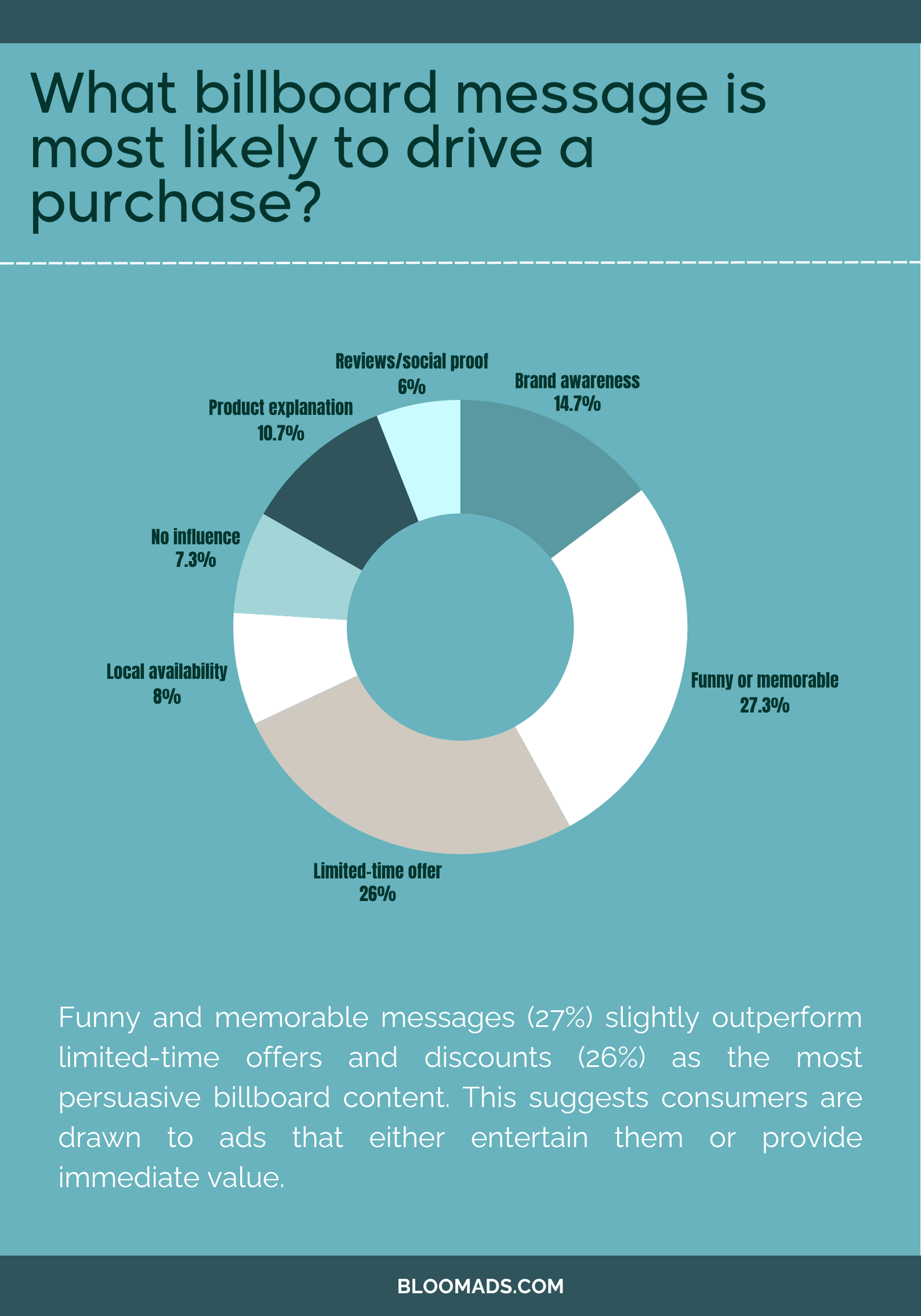
This ranking holds across formats, but the implication differs by placement. Digital formats with short rotation windows reward punchy, immediate messaging. Static formats and interior transit placements can sustain slightly more information. Specialty formats live or die by creativity.
Billboard costs vary significantly based on format, market size, location, and contract length. The figures below represent general ranges and are intended to give a realistic starting point for budget planning. Actual quotes from operators will reflect local market conditions.
Static billboards: In smaller markets, static highway billboard rentals can start around $750 to $2,000 per month. In mid-size markets along major corridors, expect $2,000 to $8,000 per month. Premium urban locations in large markets can reach $15,000 to $50,000 per month or more. Production costs for a vinyl print typically run $500 to $1,500 depending on size and number of panels.
Digital billboards: Because digital boards rotate multiple advertisers, individual buys are typically sold in four-week packages. Costs range from roughly $1,500 per month in smaller markets to $10,000 or more per month in major metro areas for a standard rotation. Premium digital locations in markets like New York, Los Angeles, or Chicago can reach $50,000 and above. Creative production for digital typically costs $300 to $1,500 per static or animated file depending on complexity.
Mobile billboards: Truck billboard campaigns are often sold by the day or week. Daily rates typically run $500 to $1,500 for a single vehicle in a local market. Digital mobile billboard trucks command a premium, often $1,000 to $3,000 per day. Multi-week campaigns generally come with volume discounts.
Transit advertising: Bus shelter panels and interior cards tend to start around $300 to $1,000 per location per month in regional markets, with full bus wraps running $2,500 to $10,000 per month per vehicle. Airport advertising ranges widely, from $2,000 per month for smaller terminal panels to $100,000 or more for a major hub takeover.
Wallscapes and specialty formats: Wallscapes and spectaculars are custom projects, and costs reflect the complexity of the installation. A mid-sized wallscape in an urban market might run $10,000 to $30,000 per month. Major spectaculars in premium markets can run into the hundreds of thousands per month. 3D production elements add significant cost to both physical and digital anamorphic executions.
The most useful way to evaluate billboard costs is not rate per month but cost per thousand impressions, or CPM, which normalizes spend against actual reach. Outdoor advertising generally delivers among the lowest CPMs of any advertising channel, which is part of why brands that invest in it consistently see it compete favorably with digital formats on a pure efficiency basis.
Ready to plan a campaign? The team at Bloom Ads can help you identify the right formats, locations, and messaging strategy for your goals. Contact us to get started.